

What Is Substructure in Market Structure?
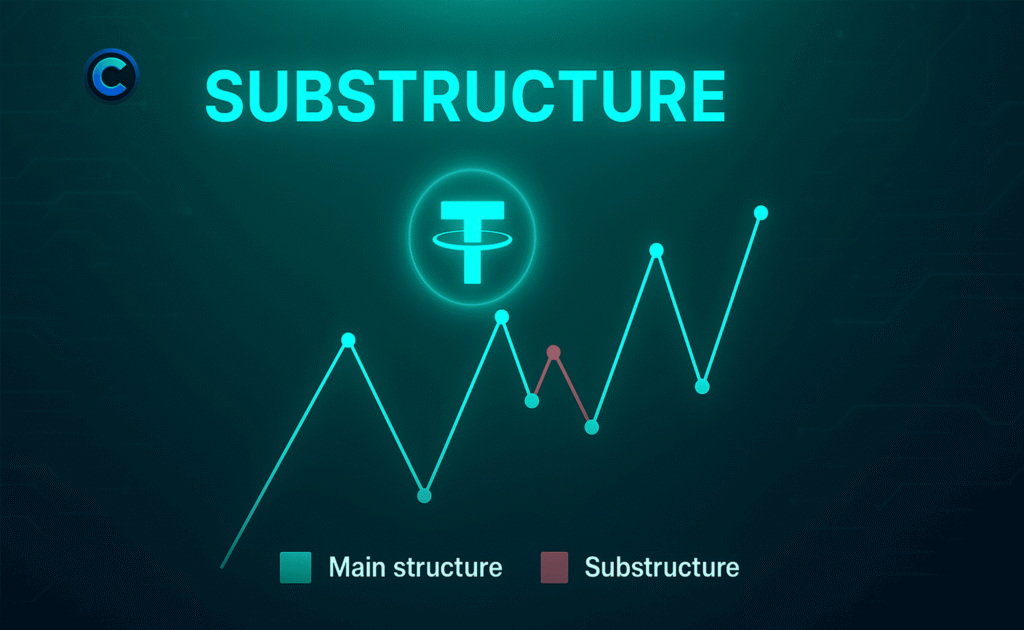
Substructure in trading is an internal market structure that forms inside the main market structure without breaking it.
In other words, price can create its own highs, lows, and breakouts inside a larger trend, while the overall market direction remains unchanged.
Substructure is a key concept in Smart Money trading because it explains why price often moves in phases, creates temporary trends, and traps traders who only focus on a single timeframe.


In these examples, the main structure remains intact, but price develops smaller internal movements that can look like a full trend on lower timeframes.
Main Structure vs Substructure
Understanding substructure in trading requires a clear distinction between main structure and internal structure.
To understand substructure correctly, you must clearly separate main structure and internal structure.
Main Structure
- Formed on higher timeframes (H4, Daily, Weekly)
- Defines the dominant market direction
- Changes only after a confirmed Break of Structure (BOS)
Substructure
- Forms inside the main structure
- Often visible on lower timeframes (M5, M15, M30)
- Can be bullish inside a bearish trend, or bearish inside a bullish trend
- Does not invalidate the main trend unless it breaks it
This distinction prevents one of the most common trading mistakes:
confusing a substructure move with a full trend reversal.
Why Substructure Exists
Substructure in trading forms because markets are fractal by nature.
Large players (institutions, smart money) do not enter positions all at once. Instead, they:
- Accumulate positions
- Distribute liquidity
- Create internal highs and lows
- Engineer false breakouts
As a result, price creates temporary internal trends that serve a purpose:
- Liquidity collection
- Entry refinement
- Stop hunts
- Position building
Substructure is not noise — it is intentional price behavior.
Substructure Without Breaking the Main Structure
One of the most important rules:
A substructure can break internally without breaking the main structure.
This means:
- Internal BOS does not equal trend reversal
- Only a break of the main structure matters for direction change
Traders who ignore this rule often:
- Enter counter-trend trades too early
- Get stopped out repeatedly
- Trade against smart money
Understanding substructure helps you stay aligned with higher-timeframe bias.
Trading With the Main Structure Using Substructure
The safest way to trade substructure is in the direction of the main structure.
To do this, you must wait for structure alignment, also called structure synchronization.
What Is Structure Synchronization?
Structure synchronization occurs when:
- The main structure defines the trend
- The substructure breaks in the same direction as the main structure
This confirms that internal price action is now supporting the higher-timeframe bias.
For the best chart analysis experience, open these structures directly on TradingView.


In these examples, the trader waits for the substructure to break toward the main structure direction, confirming continuation rather than reversal.
Entry Logic Using Substructure in Trading
Entry logic using substructure in trading allows traders to align precise entries with the higher-timeframe trend.
A professional approach to substructure trading looks like this:
- Identify the main structure direction
- Observe the internal substructure
- Wait for substructure to form a valid internal range
- Look for a break of substructure in the direction of the main trend
- Enter on:
- Pullback
- Retest
- Liquidity sweep + confirmation
This approach allows:
- Better entries
- Tighter stop losses
- Higher risk-to-reward ratios
Common Mistakes When Trading Substructure
1. Treating Substructure as Trend Reversal
Internal BOS does not mean the trend has changed.
2. Ignoring Higher Timeframes
Substructure only makes sense when viewed inside the main structure context.
3. Overtrading Internal Moves
Not every internal break is tradable. Focus on alignment, not activity.
4. Entering Without Confirmation
Substructure should confirm your bias, not contradict it.
Why Substructure Is Critical for Smart Money Trading
Smart Money concepts rely on context and hierarchy:
Substructure reveals:
- Where smart money is accumulating
- How price prepares for continuation
- Why retail traders get trapped
Once you understand substructure, price action becomes clearer and more logical.
Final Thoughts
Substructure in trading is not a separate strategy — it is a layer of market understanding.
By learning to:
- Distinguish main structure from substructure
- Wait for structural alignment
- Trade only confirmed continuation
You move closer to institutional-style execution instead of reactive retail trading.
Mastering substructure gives you patience, clarity, and precision — all essential traits of consistent traders.
More guides here.
Market Structure Change: BOS (Break of Structure) Explained
About the Author

3 thoughts on “Substructure in Trading: How Internal Market Structure Works”