
When people first hear about Ethereum, they often assume it’s just another cryptocurrency like Bitcoin. Something you buy, watch on a chart, maybe trade, maybe hold and hope the price goes up. That assumption is understandable — but it’s also incomplete.
Ethereum for beginners are not just digital money. In fact, money is only a small part of what Ethereum was designed to do.
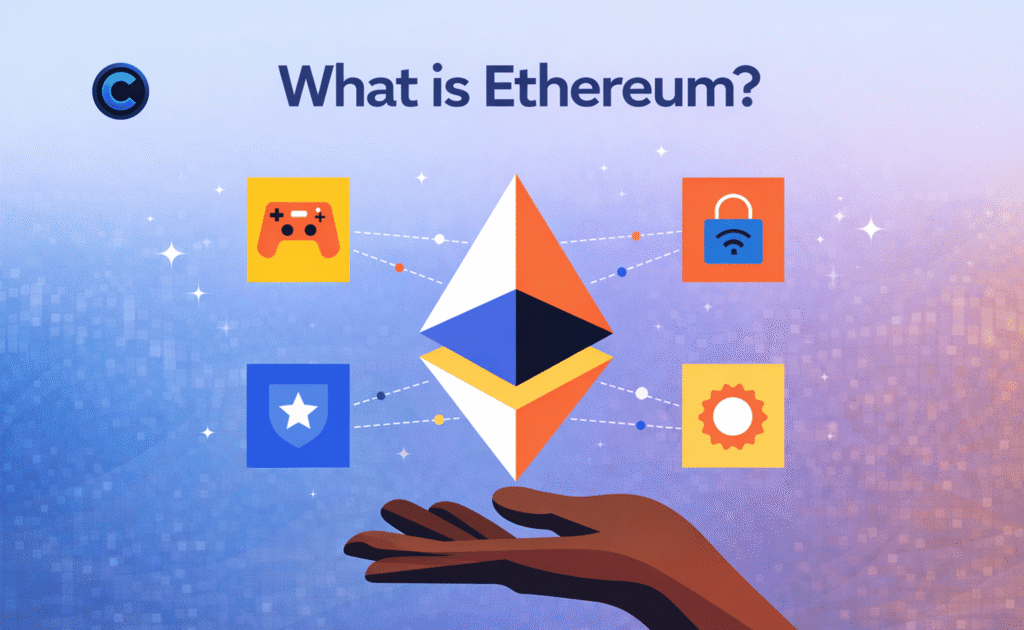
Ethereum is better understood as a new kind of internet infrastructure. One that allows people to build applications, make agreements, move value, and interact financially — without relying on banks, platforms, or centralized companies.
To understand why Ethereum exists and why so many developers, investors, and institutions care about it, we need to start with the problem it was trying to solve.
Why Ethereum Was Created in the First Place
Bitcoin proved something radical: money can exist without banks.
For the first time in history, people could send value directly to each other over the internet without asking permission from a financial institution. No bank account. No intermediary. No central authority deciding who is allowed to participate.
That alone was revolutionary.
But after Bitcoin launched, developers started asking a different question.
What if it wasn’t just money that could work without intermediaries?
What if agreements, applications, financial products, games, databases — even entire organizations — could run without a central owner or controller?
That question led to Ethereum.
Ethereum launched in 2015 with a very different goal than Bitcoin. Bitcoin was designed to be sound, decentralized money. Ethereum was designed to be a global, decentralized computing platform.
Instead of focusing only on payments, Ethereum focused on programmability.
Ethereum in Simple Terms
If Bitcoin is digital gold, Ethereum is more like a global computer.
But not a computer owned by one company.
Not a server controlled by a government.
A shared computer made up of thousands of independent machines around the world, all running the same open software and agreeing on the same rules.
Anyone can use it. Anyone can build on it. No one owns it.
That’s the core idea behind Ethereum.
Ethereum vs Bitcoin: Not Competitors, Different Tools
A common beginner mistake is to think Ethereum is “trying to beat” Bitcoin.
It isn’t.
Bitcoin and Ethereum solve different problems.
Bitcoin focuses on being:
- simple
- secure
- predictable
- resistant to change
Ethereum focuses on being:
- flexible
- programmable
- adaptable
- capable of supporting complex applications
Bitcoin intentionally avoids complexity. Ethereum embraces it.
That’s why Ethereum can support things like decentralized finance, NFTs, stablecoins, and autonomous applications — while Bitcoin largely does not.
What Actually Runs on Ethereum?
Ethereum allows developers to create applications that live directly on the blockchain. These applications don’t sit on a company’s server. They don’t belong to a single owner. And once deployed, they run exactly as programmed.
These applications are commonly called dapps (decentralized applications).
Some examples of what already exists on Ethereum:
Decentralized exchanges where people trade crypto directly with each other.
Lending platforms where users borrow and earn interest without banks.
Stablecoins that move dollars globally without relying on the traditional banking system.
Games where items are owned by players, not the game company.
Financial protocols managing billions of dollars without a central company.
All of this runs on Ethereum today.
Smart Contracts: The Engine Behind Ethereum
At the heart of Ethereum are smart contracts.
A smart contract is simply a piece of code that automatically executes when certain conditions are met.
Think of it like a vending machine.
You insert money, select a product, and the machine delivers exactly what it’s programmed to deliver. No cashier. No trust required. Either the conditions are met, or nothing happens.
Smart contracts work the same way — but instead of soda, they handle money, agreements, ownership, and logic.
Once a smart contract is deployed to Ethereum:
- it cannot be altered
- it runs automatically
- it does not need permission
- it cannot be censored
This is what makes Ethereum powerful — and also what makes it unforgiving.
Ethereum Is Open, Permissionless, and Global
Ethereum is not owned by a company.
It’s not controlled by a government.
Anyone with an internet connection can:
- create an Ethereum wallet
- send or receive ETH
- interact with applications
- build new tools on top of the network
No approval required.
This openness is one of Ethereum’s greatest strengths — and also one of its biggest challenges.
Ether, ETH, and Ethereum: What’s the Difference?
This confuses almost everyone at first.
Ethereum is the name of the network.
Ether is the native currency of the Ethereum network.
ETH is simply the ticker symbol people use when talking about Ether.
In practice, most people just say “Ethereum” when they really mean ETH.
ETH is used for two main purposes:
- Sending and storing value, similar to Bitcoin
- Paying fees to use the Ethereum network
These fees are called gas.
Gas Fees Explained Simply
Every action on Ethereum costs computational effort.
When you:
- send ETH
- interact with a smart contract
- use a decentralized app
You pay a fee in ETH.
That fee compensates the network participants who keep Ethereum running.
When the network is busy, gas fees increase. When it’s quiet, they decrease.
This is one of Ethereum’s most discussed issues — and one of the reasons major upgrades were needed.
Is Ethereum Secure?
Ethereum itself is extremely secure.
It is protected by cryptography, decentralization, and thousands of independent validators around the world. The core protocol has been tested continuously for years and is among the most scrutinized systems in existence.
However, applications built on Ethereum are only as secure as their code.
If a developer makes a mistake, the blockchain will still execute that mistake perfectly.
This is why research, caution, and understanding are essential when using Ethereum-based applications.
How Ethereum Actually Works (Without the Jargon)
Ethereum works by keeping a shared record of all activity on the network.
This record is called the blockchain.
Instead of one central database, copies of this record are distributed across thousands of computers. Every new transaction or contract interaction must be verified and agreed upon by the network.
Ethereum goes one step further than Bitcoin by including a virtual execution layer — often described as a “world computer.”
This allows Ethereum not only to record transactions, but to run logic.
That’s what makes smart contracts possible.
Ethereum 2.0 and the Shift to Proof of Stake
Originally, Ethereum used the same security model as Bitcoin: Proof of Work.
This required large amounts of electricity and created scalability issues as the network grew.
In September 2022, Ethereum completed one of the most complex upgrades in blockchain history — transitioning to Proof of Stake.
This upgrade is often referred to as Ethereum 2.0.
Instead of miners competing with hardware and energy, Ethereum now relies on validators who lock up ETH as collateral.
This change:
- reduced energy consumption dramatically
- improved security incentives
- laid the groundwork for future scalability upgrades
What Is Staking on Ethereum?
Staking means locking up ETH to help secure the network.
Validators who stake ETH participate in verifying transactions and maintaining the blockchain. In return, they earn rewards.
The more ETH staked and the longer it’s committed, the greater the potential rewards — but also the greater the responsibility.
Staking aligns incentives: those who have the most to lose are motivated to act honestly.
Why Ethereum Has Value
Ethereum’s value doesn’t come from scarcity alone.
It comes from utility.
Ethereum is used every day by:
- developers
- traders
- investors
- institutions
- applications managing billions in value
ETH is required to use the network. As usage grows, demand for ETH grows.
That’s the fundamental economic driver behind Ethereum.
How Beginners Usually Buy and Store Ethereum
Most beginners start by buying ETH on a centralized exchange.
From there, ETH can be stored:
- on the exchange (custodial)
- in a software wallet
- in a hardware wallet for long-term storage
As users become more comfortable, many choose to take control of their own keys and interact directly with Ethereum applications.
This step represents a shift from convenience to sovereignty.
Ethereum’s Role in the Future

Ethereum is not finished.
It’s evolving.
Future upgrades aim to:
- reduce fees
- increase transaction speed
- support global-scale usage
More importantly, Ethereum continues to attract developers building systems that challenge traditional finance, ownership, and coordination.
Whether Ethereum succeeds completely or not, it has already changed how people think about money, applications, and trust.
Final Thoughts for Beginners
Ethereum can feel overwhelming at first.
That’s normal.
It sits at the intersection of finance, technology, and economics — fields that are complex even on their own.
The key is understanding this:
Ethereum isn’t about getting rich quickly.
It’s about removing intermediaries.
It’s about giving people direct access to financial and digital systems.
And it’s about experimenting with what the internet can become when trust is built into the code itself.
Related Guide:
Liquidity in Trading: The Concept of Market Liquidity Explained
About the Author